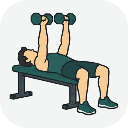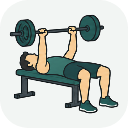
The bench press is the standard barbell test of upper-body pressing strength, and the lift most people mean when they ask what you lift. It trains the chest, front delts and triceps together under a load you can add to in small steps, which is what makes it a progression anchor rather than just a chest exercise.
How to do it
- Plant both feet and keep your shoulder blades pulled together against the bench.
- Lower the bar to the middle of your chest with your elbows around 45° from your body.
- Press back up in a straight line and stop just short of locking out.
Common mistakes
- Bouncing the bar off your chest — it hides how much you actually pressed.
- Flaring your elbows to 90°, which moves the load onto the shoulder joint.
What it trains
- Chest
- drives the arms together and up — the prime mover through the whole press
- Front delts
- take over as the bar leaves the chest, and take more of it the more you incline
- Triceps
- finish the rep — usually what gives out first near lockout on a close grip
- Upper back
- holds the shoulder blades tight so you press from a stable base, even though it never moves
Variations and alternatives
Common questions
How much should I be able to bench press?
There is no number you should hit — bodyweight for a set of five is a common milestone for men and roughly half that for women, but both vary enormously with limb length, training age and how you are built. The useful comparison is your own last session, which is the one StackUp actually tracks.
Should my elbows be tucked or flared?
Around 45° from your torso. Fully flared to 90° puts the shoulder joint at the end of its range under load, and fully tucked turns it into a close-grip press that the triceps limit. Tuck slightly more as the weight gets heavy.
How many reps should I do?
Five to eight if you are chasing strength, eight to twelve if you are chasing size, and the difference matters less than adding weight over months. Set a rep range in StackUp and it suggests the next weight when you top it out.
Do I need a spotter?
For heavy sets to failure, yes, or use a rack with the safety pins set just below your chest. A bench press is the one common lift where failing a rep alone can trap you under the bar.
In StackUp. Logged as weight and reps per set, and your heaviest working set decides whether the weight goes up next time. Get the app.
Chest