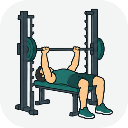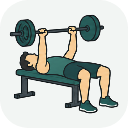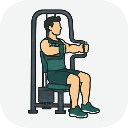
The machine chest press trains the same push as a bench press on a fixed path, so nothing is spent on balancing the weight. That makes it a straightforward way to add chest volume — and the easiest pressing movement to take close to failure safely, because there is no bar to get stuck under.
How to do it
- Seat height first: the handles should line up with the middle of your chest.
- Press out and let the weight come back under control instead of dropping it.
Common mistakes
- Setting the seat too high, which turns a chest press into an awkward incline.
What it trains
- Chest
- the prime mover, and it stays the prime mover because the machine removes the balancing work
- Front delts
- assist through the press, more so on a machine set to a high seat
- Triceps
- extend the elbows to finish each rep
Variations and alternatives
Common questions
Is the machine chest press as good as a bench press?
For building the chest, close. For everything else the bench press asks of you — stabilising a free weight, bracing, carrying over to other lifts — no. Most people are best served using the machine as volume alongside a barbell press rather than instead of one.
How do I set the seat height?
So the handles sit level with the middle of your chest, roughly at nipple height. Too high turns it into a shoulder press; too low pushes the load onto the upper chest and cramps the shoulder.
Why can I press more on the machine than on a bench?
Because the machine holds the path for you and often assists through a cam. The numbers are not comparable between the two, or even between two machines from different makers — track them as separate exercises, which is what StackUp does by default.
In StackUp. Logged as weight and reps per set, and your heaviest working set decides whether the weight goes up next time. Get the app.
Chest