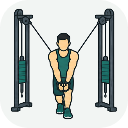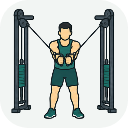
The cable fly is a chest fly done between two pulleys set at roughly shoulder height, so the resistance pulls straight back along the line of your arms for the whole rep. That constant tension is the point — a dumbbell fly is hardest at the bottom and nearly weightless at the top, while a cable keeps loading the chest right through the squeeze.
How to do it
- Step forward so there is tension on the cables before your first rep.
- Elbows softly bent and fixed. Bring your hands together in an arc, not a press.
Common mistakes
- Bending and straightening the elbows, which quietly turns the fly into a press.
What it trains
- Chest
- pulls the arms together across the body, working hardest at the end where a dumbbell version has nothing left
- Front delts
- assist the arms forward and take more of it the lower the pulleys are set
- Core
- stops the cables pulling you backwards — this is why you stagger your stance
Variations and alternatives
Common questions
What height should I set the cables?
Shoulder height for the standard version, which hits the chest most evenly. Set them high and you press down and in, which favours the lower chest; set them low and you sweep up, which favours the upper. All three are worth using, just not in the same set.
Should my elbows be locked or bent?
Slightly bent and held there. A locked elbow turns a long lever into a shoulder strain, and an elbow that keeps bending through the rep quietly turns the fly into a press. Fix the angle at the start and think of your hands as being on the end of hooks.
Do I need to cross my hands over at the front?
Not really, but it does not hurt. Crossing lets the arm travel a little further across the body, which is the direction the chest actually pulls. If you cross, alternate which hand is on top so you are not always training one side through a longer range.
In StackUp. Logged as weight and reps per set, and your heaviest working set decides whether the weight goes up next time. Get the app.
Chest