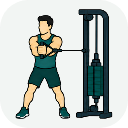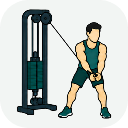
The cable woodchop pulls a handle diagonally across your body, high to low or low to high, so the trunk rotates under load. It is the loadable rotation exercise — the Russian twist done standing with a stack behind it, and with the hips free to pivot the way they do in any real turning movement.
How to do it
- Pivot the back foot and rotate through the hips, keeping the arms fairly straight.
- High to low or low to high — both work; pick a line and stay on it.
Common mistakes
- Pulling with the arms while the hips stay locked.
What it trains
- Obliques
- drive the rotation across the body — the prime mover
- Abs
- transmit the turn between ribcage and pelvis
- Glutes and hips
- pivot the lower half so the rotation is not all spine
- Shoulders
- hold the arms out and guide the handle along the diagonal
Variations and alternatives
Common questions
High to low or low to high?
Both, and they are not the same. High to low tends to feel stronger and lets you use more weight; low to high puts the obliques in a longer stretch at the start. Running one of each in a session is a reasonable default.
Should my hips rotate on a woodchop?
Yes — let the back foot pivot. Locking the hips forces the whole rotation into the spine, which both caps the weight and makes the movement awkward. Anti-rotation is a different exercise, and that one is the Pallof press.
Should I use a rope or a single handle?
A rope lets the hands separate at the end of the arc and usually feels smoother. A single D-handle keeps the path tighter and is fine. Neither changes what the obliques are doing, so use whichever the gym has free.
In StackUp. Logged as weight and reps per set, and your heaviest working set decides whether the weight goes up next time. Get the app.
Core