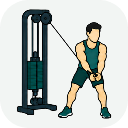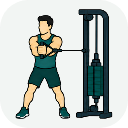
The Pallof press stands you side-on to a cable, holds the handle at your chest, and presses it straight out while the cable tries to rotate you. Nothing visibly moves except your arms — the exercise is entirely about not twisting, which makes it the odd one out in a group full of crunching.
How to do it
- Stand side-on to the cable and press straight out from the chest.
- The work is resisting the rotation, not producing it.
Common mistakes
- Letting the torso turn toward the machine as the arms extend.
What it trains
- Obliques
- resist the rotation the cable is applying — the whole exercise
- Abs
- keep the ribcage down and the trunk braced as the arms extend
- Glutes
- hold the hips square so the resistance goes into the trunk, not into you turning
- Shoulders
- hold the handle out at arm's length, where the leverage is worst
Variations and alternatives
Common questions
How much weight should I use on a Pallof press?
Light enough that you can hold the extended position without your torso turning at all. If you are bracing against the floor with your feet or leaning away from the machine, it is too heavy — this is one of the few exercises where more weight genuinely makes it a worse set.
What is an anti-rotation exercise actually for?
Training the trunk to stay still while something tries to twist it, which is what it spends most of its time doing in carrying, pressing and single-sided work. It is a different job from crunching, and most routines only train the crunching half.
Should I hold the press out or do reps?
Both work. Reps with a one to two second pause at full extension is the usual version; holding for 20 to 30 seconds per side is the same exercise as an isometric. Pick one so your log means something.
In StackUp. Logged as weight and reps per set, and your heaviest working set decides whether the weight goes up next time. Get the app.
Core