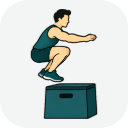
The box jump is a jump from the floor onto a box, landing softly in a squat and stepping back down. It trains power — how fast your legs can produce force — and the box has a useful side effect: it cuts the landing short, so you get the jump without the full impact of coming back to the floor. Every rep is meant to be a fresh, high-quality jump, not a way to get tired.
How to do it
- Stand close to the box, dip into a quarter squat and swing the arms back.
- Drive the arms up as the hips snap open, and land softly on both feet in a squat.
- Stand up tall on the box, then step down one foot at a time.
Common mistakes
- Picking a box so high that you land in a deep squat with the knees caving in — use the height you land on quietly.
- Jumping back down off the box instead of stepping.
What it trains
- Quads
- extend the knees explosively for take-off and absorb the landing on the box
- Glutes
- snap the hips open for take-off, together with the swing of the arms
- Calves
- add the last push off the balls of the feet and steady the landing
- Core
- keeps the torso stiff so the force from the legs goes up instead of into a bend at the waist
Variations and alternatives
Common questions
How high should the box be?
Low enough that you land in about the same quarter squat you took off from, feet flat and quiet — for most people starting out, somewhere around 30 to 50 cm. If you have to yank your knees to your chest to make it, the box is measuring how well you tuck, not how high you jump. Write the height in the exercise note so you are comparing like with like.
Should I jump down or step down?
Step down. Jumping off the box adds a hard landing from the full height to every rep, and it trains nothing the jump up did not already train. Step down one foot at a time, reset your stance and jump again.
How many box jumps should I do?
Few, with full rest — three to five a set, stopping while every jump is still as high and as quiet as the first. Plyometrics are about power, and a tired jump is a slower one, so sets of fifteen turn them into conditioning. StackUp progresses rep-based exercises by raising the target reps and starts from a 10 to 15 range by default, so give this one a low range of its own, such as 3 to 5.
Do box jumps improve your vertical jump?
They can, because they train the same take-off, but the box height is a poor measure of it. How far you can pull your knees up decides a lot of how high a box you can land on, so a new box record is often mobility and nerve rather than a better jump. If jumping higher is the goal, keep the box moderate and judge each jump by how easily you clear it.
In StackUp. Logged as reps per set. Add weight if you use a belt or a dumbbell and StackUp progresses it like any other lift. Get the app.
Legs