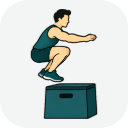
The tuck jump is a vertical jump where you pull both knees up toward your chest at the top, then straighten the legs again before you land. It asks for a fast take-off and quick hip flexors at the same time, which makes it one of the hardest jumps to do well and the first to fall apart when you are tired. A few good ones are worth more than many sloppy ones.
How to do it
- Dip quickly into a quarter squat with the arms swinging back.
- Jump first, then pull both knees up toward your chest at the top.
- Straighten the legs again before you land, and touch down softly with the knees over the toes.
Common mistakes
- Bending the chest down to the knees instead of lifting the knees to the chest.
- Chaining reps together until the landings turn heavy and loud.
What it trains
- Quads
- extend the knees for take-off and absorb every landing
- Glutes
- extend the hips to get you high enough off the floor to tuck at all
- Calves
- finish the take-off and cushion landings that come quickly one after another
- Hip flexors
- snap the knees up at the top — what separates this from a squat jump
- Abs
- curl the pelvis up with the knees and keep the torso upright in the air
Variations and alternatives
Common questions
What is the difference between a tuck jump and a squat jump?
The knees. A squat jump stays straight in the air; a tuck jump pulls the knees up to the chest at the top, which brings in the hip flexors and abs and asks for a lot more coordination. Learn the squat jump first — the tuck only works on top of a take-off that is already high enough.
Do my knees have to touch my chest?
No — aim for your thighs coming up to about parallel with the floor. Folding your chest down to meet your knees makes the tuck look bigger while the jump gets lower, and it leaves you landing bent over. Bring the knees up to you, not yourself down to them.
How many tuck jumps should I do?
Sets of about three to six, with enough rest that the next set starts as high as the first. When the knees stop coming up or the landings get loud, the set is over. StackUp raises your target reps once you beat your rep range, so keep that range low for this exercise — more reps is not what makes a tuck jump better.
Are tuck jumps cardio?
They will get your heart rate up, but that is a side effect. Done for time in a circuit they turn into conditioning and the tuck shrinks to a hop; done in short sets with rest they train power, which is what they are good at. If cardio is what you want, jumping jacks or a jump rope get you there with far less pounding.
In StackUp. Logged as reps per set. Add weight if you use a belt or a dumbbell and StackUp progresses it like any other lift. Get the app.
Legs