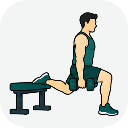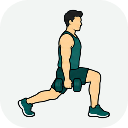
The lunge jump starts in a lunge, explodes straight up and switches legs in the air, landing in a lunge with the other foot in front. It is the single-leg version of a jump: the front leg does most of each take-off, and every landing has to be caught in a split stance, so it trains power and balance together. Because it asks so much of both, treat it as power work with full rest, not as a finisher at the end of a session.
How to do it
- Start in a lunge, both knees bent, torso upright.
- Jump straight up, switch legs in the air and land with the other foot in front.
- Sink softly into the next lunge — every landing counts as one rep.
Common mistakes
- Letting the back knee slam into the floor on the landing.
- Leaning forward over the front leg, which turns the jump into a stumble.
What it trains
- Quads
- drive the take-off from the front leg and brake the landing on the new front leg
- Glutes
- extend the front hip for the jump and hold the pelvis steady as you land split
- Hamstrings
- help extend the hip and control the drop into each landing
- Calves
- push off from both feet and absorb the first contact of every landing
- Core
- keeps the torso upright while the legs switch underneath it
Variations and alternatives
Common questions
How do I count reps on lunge jumps?
Count every landing as one rep. Each jump is a full rep whichever leg lands in front, and because the legs alternate, an even number gives both sides the same work. Ten landings is ten reps — log it that way every time so the numbers stay comparable.
Are lunge jumps hard on the knees?
Harder than most leg exercises, because every rep ends with a landing on one bent front leg, so build up to them rather than starting here. Get comfortable with split squats and reverse lunges first, keep the front knee pointing the same way as your toes, and end the set when the landings get heavy.
How low should I land?
Low enough to catch the landing with both knees bent to roughly 90°, but the back knee should never hit the floor. Landing high on nearly straight legs skips the part that makes it a lunge; landing so deep that the knee taps down means the jump has outrun your control.
How many lunge jumps should I do?
About six to ten landings a set, stopping while you can still land every one in a controlled lunge. StackUp suggests your next target reps from the rep range you set for the exercise, and its default of 10 to 15 is high for a jump — set something like 6 to 10 here, so it never asks for more reps than you can land well.
In StackUp. Logged as reps per set. Add weight if you use a belt or a dumbbell and StackUp progresses it like any other lift. Get the app.
Legs