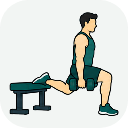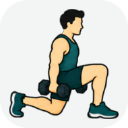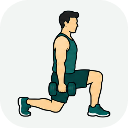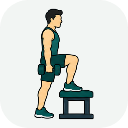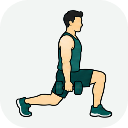
The split squat is the stationary lunge: you set your feet in a split stance and go straight up and down without stepping. Both feet stay on the floor, which makes it far more stable than a Bulgarian split squat and easier to load heavy, and because you never step it is the single-leg movement that asks least of your balance.
How to do it
- Both feet stay planted — this is a lunge that never moves.
- Drop the back knee toward the floor rather than pushing the front knee forward.
Common mistakes
- Leaning forward over the front thigh as the set gets hard.
What it trains
- Quads
- extend the front knee — the prime mover, and more so the more upright you stay
- Glutes
- extend the front hip out of the bottom
- Hamstrings
- assist the front hip and control the descent
- Adductors
- stabilise the split stance, particularly on the back leg
Variations and alternatives
Common questions
Split squat or Bulgarian split squat?
Split squat if you want to load it heavy or you are new to single-leg work — both feet on the floor means your balance is not the limit. The Bulgarian version takes the back leg out of the drive, which makes it harder per kilo but caps how much you can actually use.
How far apart should my feet be?
Far enough that your front shin is close to vertical at the bottom and your back knee lands under or slightly behind your hip. Short stance means more knee and quad, long stance means more hip and glute — neither is wrong, just pick one.
Should I hold dumbbells or use a barbell?
Dumbbells at your sides for most people, because loading is easy and you can drop them. A barbell on your back lets you go heavier once dumbbells run out, and a front-rack hold keeps you more upright if the quads are the target.
In StackUp. Logged as weight and reps per set, and your heaviest working set decides whether the weight goes up next time. Get the app.
Legs