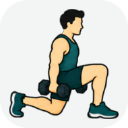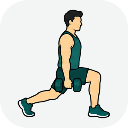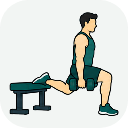
The Bulgarian split squat is a split squat with the back foot up on a bench, which takes the rear leg out of the drive almost entirely and leaves the front leg doing the work over a longer range. It is the hardest of the single-leg movements to balance, and the one that gets the most out of the least weight — a pair of 20s can be a genuinely brutal set.
How to do it
- Rear foot on a bench, front foot far enough forward that the knee stays over the mid-foot.
- Lower straight down. The back leg balances; the front leg does the work.
Common mistakes
- Standing too close to the bench, which jams the front knee forward.
What it trains
- Quads
- extend the front knee out of a deep bottom position — the prime mover
- Glutes
- extend the front hip, and take much more of it if you lean the torso forward
- Hamstrings
- assist at the hip and control the descent on the working side
- Abductors
- stop the front knee drifting inward, which is most of why it feels unstable
Variations and alternatives
Common questions
How far should the bench be from my front foot?
Far enough that your front shin is roughly vertical at the bottom and your back knee comes close to the floor without your hips being dragged backward. If your front heel lifts, you are too close; if it feels like a stretch rather than a squat, you are too far.
Why can I barely balance on this?
Because the rear foot is on a bench, so it gives you almost no side-to-side support and the front leg has to do the stabilising. Balance is a skill here and it improves in a few sessions — hold a rack upright with one hand for the first couple of weeks rather than dropping the weight.
Should I lean forward or stay upright?
Upright loads the quads, leaning forward from the hips loads the glutes. Both are legitimate — just pick one and keep it consistent, because switching mid-programme changes what the numbers mean.
How do I track a single-leg exercise?
Log it as one exercise with the reps you did per leg, not the total. Doing five each side and calling it ten makes the number look like it grew when it did not, and StackUp will suggest more weight off a rep count you never actually hit on one leg.
In StackUp. Logged as weight and reps per set, and your heaviest working set decides whether the weight goes up next time. Get the app.
Legs