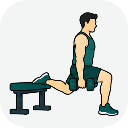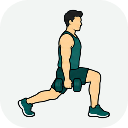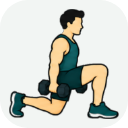
The dumbbell lunge is the forward lunge with a dumbbell in each hand: step out, lower until the back knee nearly touches the floor, and push back to standing. The weights hang low at your sides and are easy to put down, which makes this the simplest way to load a single-leg movement properly. Each leg works on its own, so a weaker side shows up instead of hiding behind the stronger one.
How to do it
- Stand tall with a dumbbell in each hand, arms hanging at your sides.
- Step forward and lower until the back knee is just above the floor, front shin close to vertical.
- Push hard through the front foot to step back to the start.
Common mistakes
- Stepping so short that the front heel lifts and the knee takes all the load.
- Letting the front knee cave inward as you push back up.
What it trains
- Quads
- extend the front knee to push you back up — the prime mover
- Glutes
- extend the front hip, and take more of the work the longer your step
- Hamstrings
- assist the hip and help brake the step forward
- Abductors
- stop the front knee drifting inward as you land the step and drive back
- Forearms
- hold the dumbbells, and can end a heavy set before the legs do
Variations and alternatives
Common questions
Do I log both legs?
No — log the reps of one leg. If you alternate, ten lunges in total is five per leg, so the set is five; if you finish one side first, it is the reps you did on that side. Logging the total doubles the number, and StackUp would then judge your heaviest set against your rep range on reps no single leg ever did.
Should I alternate legs or do one side at a time?
One side at a time if you want to push the weight, alternating if you want it closer to walking. Staying on one leg keeps it under tension and makes sets easier to compare; alternating gives each leg a short break and turns heavy sets into more of a balance test. Pick one and keep it, because switching changes what the numbers mean.
How heavy should the dumbbells be for lunges?
Light enough that you can step out and back without wobbling, then build from there; if your grip gives out before your legs, straps are fair game. StackUp judges your heaviest working set against your rep range and suggests the next weight up, the same or down, in 2.5 kg steps by default. If your gym's dumbbells go up in different jumps, set this exercise's step to match.
Forward lunge or reverse lunge?
The forward lunge asks more of the front knee and your balance, because you have to brake your bodyweight and the dumbbells on it; the reverse lunge is gentler and easier to control. That braking is also what the forward version trains, so it is worth doing if your knees are happy with it. If they are not, the reverse lunge works nearly the same muscles.
In StackUp. Logged as weight and reps per set, and your heaviest working set decides whether the weight goes up next time. Get the app.
Legs