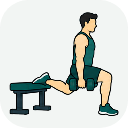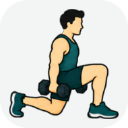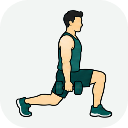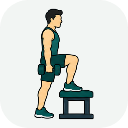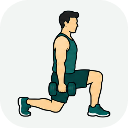
The reverse lunge steps backward into the split position instead of forward, so the front foot never moves and you never have to decelerate your bodyweight onto it. That makes it the easiest lunge on the knees and the easiest to balance, and unlike the walking version you finish every rep back where you started.
How to do it
- Step backwards rather than forwards — usually easier on the knees.
- Keep your weight on the front foot the whole time.
Common mistakes
- Pushing off the back foot, which hands the work to the leg that should be along for the ride.
What it trains
- Quads
- extend the front knee to drive you back up — the prime mover
- Glutes
- extend the front hip, and take a big share because the step back loads them stretched
- Hamstrings
- assist the front hip and control the step backward
- Calves
- stabilise the front ankle as your weight settles into the bottom
Variations and alternatives
Common questions
Reverse lunge or forward lunge — which is better?
The reverse lunge for most people. Stepping forward means catching your falling bodyweight on one knee, which is where forward lunges get their reputation for aggravating knees; stepping back lets you lower under control instead.
Should my back knee touch the floor?
Come close to it — an inch or so off — rather than resting on it. Touching down takes the tension off the front leg at the exact point it is working hardest, and on concrete it just hurts.
Should I alternate legs or finish all reps on one side?
All reps on one side, then swap. Alternating turns it into a cardio set where your breathing fails before either leg does, and it makes the sets much harder to compare session to session.
In StackUp. Logged as weight and reps per set, and your heaviest working set decides whether the weight goes up next time. Get the app.
Legs