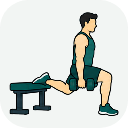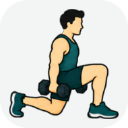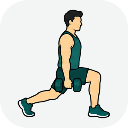
The walking lunge is a lunge that travels: you step forward into the bottom position, drive up, and pass straight through into the next step on the other leg. That continuous forward stepping makes it the most demanding lunge on balance and conditioning, and unlike a split squat you never get a stationary reset between reps.
How to do it
- Step out far enough that the front shin stays roughly vertical.
- Push through the front heel to bring the back leg forward.
Common mistakes
- Taking short steps, which turns it into a knee-dominant grind.
What it trains
- Quads
- extend the leading knee and absorb your bodyweight landing on it
- Glutes
- extend the hip to drive you forward out of each step — they take a big share of a long stride
- Hamstrings
- control the descent and assist the hip on the way through
- Abductors
- keep the hips level while you are momentarily on one leg
- Calves
- stabilise each landing and push off the trailing foot
Variations and alternatives
Common questions
How long should my stride be?
A long step loads the glutes and hamstrings, a short step loads the quads and the knee. Most people default to too short — step out far enough that your front shin stays roughly vertical when your back knee is near the floor.
How do I count reps on a walking lunge?
Count steps per leg, not total steps, and keep it consistent forever. Twenty steps is ten each side, and logging it as twenty one week and ten the next makes your history meaningless.
Why am I so much more sore after walking lunges than squats?
Because each step loads one leg while it is lengthening under your falling bodyweight, and that eccentric loading is what drives soreness. It fades as you do them regularly — start with two sets and a short distance rather than the twenty-metre gym-floor length.
Do I need weight or is bodyweight enough?
Bodyweight is a real set for most people at first, and dumbbells at your sides are the obvious next step. Carrying weight also fixes the balance problem, oddly — a load in each hand gives you something to stabilise against.
In StackUp. Logged as weight and reps per set, and your heaviest working set decides whether the weight goes up next time. Get the app.
Legs