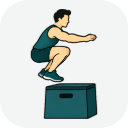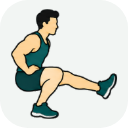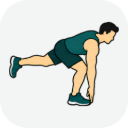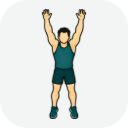
The squat jump is a quick dip into a quarter or half squat followed by a jump straight up as high as you can, landing softly and going again. It needs nothing but floor and headroom, which makes it the simplest way to add power work to a leg day. Keep the reps few and every one of them maximal: a squat jump done slow and tired is just a squat with extra impact.
How to do it
- Feet about hip-width, toes forward; dip fast into a quarter squat as the arms swing back.
- Jump straight up, driving the arms overhead and straightening hips, knees and ankles fully.
- Land softly, balls of the feet first, with the knees bent and over the toes.
Common mistakes
- Landing on stiff legs, so the impact goes into the joints instead of the muscles.
- Letting the knees cave inward on the landing as the set gets tiring.
What it trains
- Quads
- extend the knees out of the dip — the main drive of the take-off and the brake on landing
- Glutes
- drive the hips to full extension so you leave the floor standing tall
- Calves
- finish the push off the balls of the feet and cushion each landing
- Core
- keeps the torso from folding forward in the air and on landing
Variations and alternatives
Common questions
How deep should I squat before jumping?
To wherever you jump highest, which for most people is a quarter to a half squat. Sinking all the way down makes the dip slower and the jump lower; what you want is a fast, short dip that turns straight into the take-off.
Should I pause between squat jumps or bounce straight into the next one?
Either works, and they train slightly different things. Rebounding straight out of the landing uses its stretch and trains your spring; resetting before each rep makes every jump start from zero and keeps them all high. Pick one and stay with it, so your rep counts mean the same thing from session to session.
How many squat jumps should I do per set?
Around five to eight, and end the set as soon as the jumps get visibly lower. StackUp progresses rep-based exercises by raising the target reps once you beat your rep range, so give this one a low range of its own — left at the default of 10 to 15, the suggestions will keep pushing a power exercise into conditioning.
Should I add weight to squat jumps?
Only a little, and only once the bodyweight version is sharp. Light dumbbells at your sides or a weight vest make each jump harder, but more than a few kilos slows you down, and speed is the point. StackUp lets you log added weight on a rep-based exercise, so a loaded set stays distinguishable from a bodyweight one.
In StackUp. Logged as reps per set. Add weight if you use a belt or a dumbbell and StackUp progresses it like any other lift. Get the app.
Legs