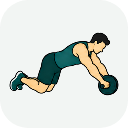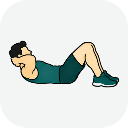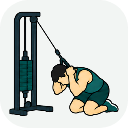
The cable crunch kneels you in front of a high pulley with a rope behind your head, curling your ribcage down towards your knees. It is the most straightforward way to train the abs as a loadable muscle: the weight stack goes up in steps, so the exercise progresses the same way a press or a row does.
How to do it
- Kneel below the rope and crunch by pulling the ribs toward the pelvis.
- Hips stay fixed — if they move, it is a hip hinge and not a crunch.
Common mistakes
- Pulling with the arms and bowing from the hips.
What it trains
- Abs
- curl the spine against the cable — the prime mover, and the only thing that should be moving
- Obliques
- stabilise against the rope pulling you off centre
- Hip flexors
- hold the kneeling position, and take over entirely if you bend at the hips
Variations and alternatives
Common questions
Why do I feel cable crunches in my hips instead of my abs?
Because you are bowing at the hips rather than curling the spine. Fix the hip angle and think about pulling your ribs towards your pelvis — the movement should be short and look almost lazy, and the weight will need to drop when you do it properly.
How do I add weight to ab training?
This is the exercise for it — a cable stack progresses in small steps, which bodyweight crunches cannot. Pick a rep range in the 10 to 15 region and let StackUp suggest the next plate when your heaviest set tops it, the same as any other lift.
Should my hips stay still?
Yes. Sit back so your weight is roughly over your heels and lock the hips there for the whole set. Every centimetre the hips travel is a centimetre the abs did not have to move you.
In StackUp. Logged as weight and reps per set, and your heaviest working set decides whether the weight goes up next time. Get the app.
Core