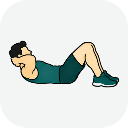
The crunch curls your shoulders off the floor a few inches and nothing else, so the abs work through the short range they actually own. It is smaller than a sit-up on purpose: the point is to flex the spine against resistance rather than to move your whole torso upright with the hip flexors.
How to do it
- Lift the shoulder blades off the floor and curl the ribs toward the hips.
- Hands beside the head, not behind it — do not pull on your neck.
Common mistakes
- Yanking the head forward, which trains the neck rather than the abs.
What it trains
- Abs
- curl the ribcage towards the pelvis — the only real movement in the exercise
- Obliques
- assist, and take more of it if you add any rotation
Variations and alternatives
Common questions
Do crunches burn belly fat?
No. Training a muscle does not remove the fat sitting over it — abs become visible through overall body fat coming down, and crunches build the muscle underneath. Both matter, but they are separate jobs.
What is the difference between a crunch and a sit-up?
A crunch lifts only the shoulder blades off the floor; a sit-up brings the whole torso up to your knees. The extra range in a sit-up comes mostly from the hip flexors, so the crunch is the more targeted ab movement of the two.
Why do I feel crunches in my neck?
You are pulling your head forward with your hands. Rest the fingertips lightly behind the ears, keep a fist-sized gap between chin and chest, and lead with the ribs rather than the chin.
How many crunches should I do?
If you can do more than about 25 clean reps, the exercise has stopped being resistance training and become endurance work. Slow the tempo down or move to a loaded version like a cable crunch rather than adding reps indefinitely.
In StackUp. Logged as reps per set. Add weight if you use a belt or a dumbbell and StackUp progresses it like any other lift. Get the app.
Core