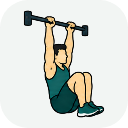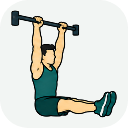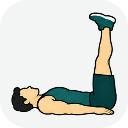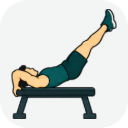
The dragon flag has you lying on a bench, gripping it behind your head, and raising your body until only your upper back touches the pad — then lowering it as one rigid line from shoulders to toes. It is among the hardest ab exercises you can do without weights, made famous by Bruce Lee, and it is best approached through easier versions rather than attempted cold.
How to do it
- Lie on a flat bench and grip it behind your head, or hold a fixed upright behind you.
- Roll up onto your upper back until your body is straight from shoulders to toes.
- Lower as one rigid line, slowly, and stop just above the bench.
Common mistakes
- Resting your weight on your neck or head instead of your shoulder blades.
- Bending at the hips to shorten the lever — that turns it into a reverse crunch.
What it trains
- Abs
- hold the body rigid against a very long lever, working hardest just above the bench
- Hip flexors
- stop the legs dropping below the line of your torso as you lower
- Lats
- pull on the bench behind your head and anchor the shoulders
- Glutes
- squeeze to keep the hips straight instead of folding to shorten the lever
Variations and alternatives
Common questions
How do I work up to a dragon flag?
Start with the lowering half only, knees tucked: get up onto your upper back however you can, then lower as slowly as you can control. Straighten one leg next, then both. Once a straight-body lowering takes three to five seconds, start pulling back up from partway down.
Where should the weight be on a dragon flag?
On your upper back and shoulder blades, never on your neck or head. Grip the bench hard, pull your shoulders into it and keep your chin slightly tucked; if you feel the load in your neck, end the set and set up again.
Did Bruce Lee invent the dragon flag?
Not that anyone can show, but he is the reason it is famous. It was part of his training and spread with his reputation. For you it changes nothing: a slow, strict dragon flag is hard for anyone.
How many dragon flags should I do?
Few: three to six slow, clean reps is a strong set, and even one good rep counts. StackUp tracks your reps per set and progresses your target reps, so count only the reps where your body stayed straight — a piked rep is an easier exercise.
In StackUp. Logged as reps per set. Add weight if you use a belt or a dumbbell and StackUp progresses it like any other lift. Get the app.
Core