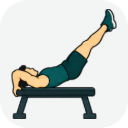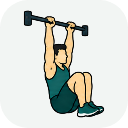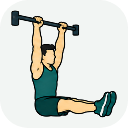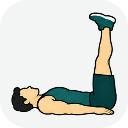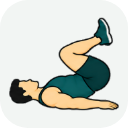
The reverse crunch works from the other end: your shoulders stay on the floor and your abs curl your hips up toward your ribs. With the knees bent the lever is short, so it is easier than a leg raise, and it still trains the part a leg raise often skips — the pelvis actually rolling up.
How to do it
- Lie on your back with the knees bent about 90° and lifted over the hips, arms flat beside you.
- Curl the hips off the floor toward your ribs without changing the knee angle.
- Lower slowly until the hips touch down, keeping the knees over the hips between reps.
Common mistakes
- Swinging the legs to throw the hips up, so momentum does the rep instead of the abs.
- Dropping back down fast instead of lowering under control.
What it trains
- Abs
- curl the pelvis toward the ribs and lift the hips off the floor — the rep itself
- Hip flexors
- hold the knees up over the hips, and take over the moment you swing the legs instead of curling
- Obliques
- keep the hips curling straight up rather than tipping to one side
Variations and alternatives
Common questions
Do reverse crunches work the lower abs?
They work the whole rectus abdominis, the same six-pack muscle a crunch does — there is no separate lower-ab muscle to isolate. What changes is which end moves, and curling the pelvis up is usually felt lower down, which is a fine reason to include them.
Why do I feel reverse crunches in my hip flexors?
Because your legs are swinging instead of your pelvis curling. Keep the knee angle fixed, think about lifting your tailbone rather than bringing your knees to your face, and accept a much smaller movement — a few centimetres of hip lift is the rep.
Should I do reverse crunches on the floor or on a bench?
Either works. On a flat bench you can hold the edge behind your head, which anchors your upper body and lets you curl a little further; on the floor, hands pressed flat beside you do the same job. Setting the bench to an incline with your head at the top makes every rep harder.
How many reverse crunches should I do?
Ten to twenty slow reps with a short pause at the top. StackUp tracks your reps per set and progresses your target reps, and once twenty clean ones come easily, the incline bench or the hanging knee raise will do more for you than a longer set.
In StackUp. Logged as reps per set. Add weight if you use a belt or a dumbbell and StackUp progresses it like any other lift. Get the app.
Core