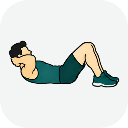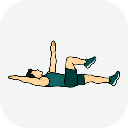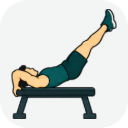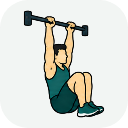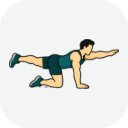
The bird dog starts on hands and knees and reaches one arm forward and the opposite leg back until both are level with your torso, then swaps sides. It looks like a warm-up, but the job is a real one: keeping your spine and hips completely still while your limbs load them unevenly. It needs nothing but a patch of floor, so it fits at the start or the end of any workout.
How to do it
- Hands under the shoulders, knees under the hips, back flat like a table.
- Reach one arm forward and the opposite leg back until both are level with your torso.
- Hold for two seconds, come back under control, then switch sides.
Common mistakes
- Kicking the leg above hip height, which arches the lower back.
- Letting the hip of the lifted leg rotate open toward the ceiling.
What it trains
- Abs
- stop the lower back sagging into an arch as the leg reaches back
- Lower back
- hold the spine long and level from head to hips while the limbs move
- Glutes
- lift the back leg to hip height — and no higher, because above that the lower back does the lifting
- Obliques
- keep the hips square when one knee leaves the floor and the body wants to tip
Variations and alternatives
Common questions
Do I log both sides?
No — log the reps of one side, not the total. Ten each side goes in as 10, which keeps your sets comparable from session to session, and StackUp progresses your target reps from that per-side number.
How do I know if I am doing bird dogs right?
Balance something on your lower back — a foam roller, a water bottle, a light plate. If it rolls off, your hips turned or your back arched; reach only as far as it stays put, and extend further as your control improves.
How long should I hold each rep?
Two to three seconds at full reach, then back under control. Rushing lets momentum do the stabilising, and the pause at the far end is where the exercise actually happens.
How do I make bird dogs harder?
Lengthen the pause first, then add a light ankle weight or hold a small dumbbell in the reaching hand. Bringing elbow and knee together under your body between reps, without touching down, works too. Adding reps is the weakest option — twenty rushed reps train less than eight slow ones.
In StackUp. Logged as reps per set. Add weight if you use a belt or a dumbbell and StackUp progresses it like any other lift. Get the app.
Core