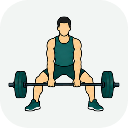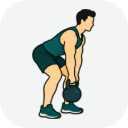
The kettlebell deadlift is a hip hinge with one kettlebell standing between your feet: push your hips back, take the handle in both hands and stand up with a flat back. The weight sits directly under you rather than out in front of your shins, which makes it the easiest place to learn the hinge before a barbell, and a solid lift in its own right wherever a kettlebell is all you have.
How to do it
- Stand with the bell between your feet, in line with your ankles, feet about hip width.
- Push the hips back, bend the knees only as far as you need to reach the handle, and brace.
- Stand up by driving the hips forward, then lower the bell the same way, hips back first.
Common mistakes
- Squatting down to the bell with the chest dropping, which turns the hinge into a squat.
- Rounding the back to reach a bell that sits too far in front of your feet.
What it trains
- Glutes
- drive the hips forward to stand you up — the main engine of the hinge
- Hamstrings
- load up as the hips travel back and help pull them through again
- Quads
- straighten the knees to get the bell off the floor
- Lower back
- holds the spine flat while you are bent over the bell
Variations and alternatives
Common questions
Is the kettlebell deadlift good for beginners?
Yes — it is the gentlest way to learn the hinge. The bell sits between your feet, so there is no bar to keep tight against your shins, and a single kettlebell is easy to set down the moment a rep goes wrong. Once the heaviest bell stops being hard for ten reps, the barbell deadlift is the natural next step.
Kettlebell deadlift or kettlebell swing?
Deadlift first, then swing. They are the same hinge at different speeds, and the deadlift lets you learn it with every rep starting and stopping on the floor. The swing is the fast version for power and conditioning, and it goes wrong quickly if the slow hinge is not already there.
How heavy should the kettlebell be?
Heavier than you would pick for an arm exercise — the hinge is one of the strongest movements you have, so a bell you could curl is far too light. Pick one that makes eight to twelve reps hard with a flat back. Kettlebells often go up in 4 kg steps, so set this exercise's weight step in StackUp to match, and the weight it suggests for next time will be a bell that actually exists.
Should the kettlebell touch the floor between reps?
Yes, lightly. Setting it down each rep keeps the lift honest and lets you reset your back — just do not drop it and bounce straight into the next rep. If you prefer constant tension, hover it a finger's width above the floor instead, but pick one way and keep it.
In StackUp. Logged as weight and reps per set, and your heaviest working set decides whether the weight goes up next time. Get the app.
Legs