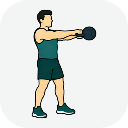
The kettlebell swing is a hip hinge done fast: the bell swings back between your legs and your hips snap it forward to chest height. Your arms do nothing but hold on, which is the thing people take longest to believe — a swing is a hinge, not a front raise.
How to do it
- This is a hinge, not a squat. The bell is thrown by the hips, not lifted by the arms.
- Snap the hips forward and let the bell float to chest height on its own.
Common mistakes
- Squatting the bell up and lifting it with the shoulders.
What it trains
- Glutes
- snap the hips forward — the engine of the movement and the only thing that should be accelerating the bell
- Hamstrings
- absorb the backswing and load the hinge at the bottom
- Lower back
- holds a flat spine while the hips move fast underneath it
- Forearms
- hang on, and are usually what ends a long set
- Abs
- brace hard at the top so the hip snap stops dead rather than becoming a lean back
Variations and alternatives
Common questions
Should the kettlebell go overhead or to chest height?
Chest height for the standard swing. The bell should float there from hip drive alone and then fall back — if you have to lift it higher with your shoulders, you have stopped doing a hinge. Overhead swings are a separate movement with their own argument, not a better version of this one.
Why do I feel swings in my lower back?
Usually because you are squatting the bell instead of hinging it, or because you are finishing with a lean back instead of a hard glute squeeze. Keep the shins near vertical, push the hips back rather than down, and at the top stand tall with the ribs down — the lockout is a plank, not an arch.
How heavy should my kettlebell be for swings?
Heavier than feels right. A bell light enough to lift with your arms teaches the wrong pattern; 16 to 24 kg is a common starting range for men and 8 to 16 kg for women, and the right one is the one that forces the hips to do it. Sets of ten to twenty, with the bell parked the moment the hinge gets sloppy.
In StackUp. Logged as weight and reps per set, and your heaviest working set decides whether the weight goes up next time. Get the app.
Full body