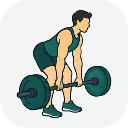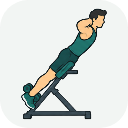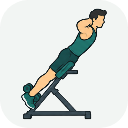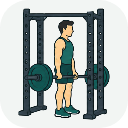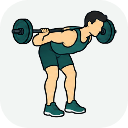
The good morning is a hip hinge with a barbell on your back — you bow forward until your hamstrings stop you, then drive the hips back under the bar. Having the load on your shoulders rather than in your hands makes it far more demanding on the lower back per kilo than a Romanian deadlift, which is why the weight is always humbling and why it trains the hinge so directly.
How to do it
- Bar high on the back, soft knees, and hinge at the hip rather than bending the spine.
- Push your hips back until you feel the hamstrings, then drive them forward again.
Common mistakes
- Treating it as a heavy lift. This is the movement that punishes ego fastest.
What it trains
- Lower back
- holds the spine flat against a bar trying to fold you over — the hardest job in the lift
- Hamstrings
- stretch under load on the way down and extend the hip to stand you back up
- Glutes
- drive the hips forward through the second half of the rise
- Abs
- brace against the bar to stop the ribcage dropping
Variations and alternatives
Common questions
How far down should I go on a good morning?
As far as you can go with a flat back, which for most people is somewhere near parallel and for some is well short of it. The moment your lower back rounds you have found the end of the useful range, and going past it is where the exercise earns its reputation.
Good mornings or Romanian deadlifts?
Romanian deadlifts if you want to load the hamstrings heavily; good mornings if you want to train the lower back holding position. The bar on your back means a much longer lever on the spine, so a good morning at 60 kg can ask more of your erectors than an RDL at 100.
Where should the bar sit?
Low bar, across the rear delts, not up on your neck. It shortens the lever slightly and stops the bar rolling up your neck as you bow forward, which is the single most common complaint about the movement.
Are good mornings safe?
They are as safe as your ability to keep a flat back at the weight you chose — the risk is entirely in rounding under load, not in the movement. Start with an empty bar, stay well inside your range, and treat 40 to 60 kg for sets of 8 as a serious working weight rather than a warm-up.
In StackUp. Logged as weight and reps per set, and your heaviest working set decides whether the weight goes up next time. Get the app.
Back