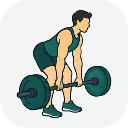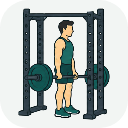
A rack pull is a deadlift starting from pins or blocks somewhere between the shin and the knee, so you skip the hardest part off the floor and load the top half heavily. It is the way to overload the upper back, traps and lockout with weights you could not pull from the ground, and it is far less taxing than a full deadlift because the range is short.
How to do it
- Set the pins just below or just above the knee, depending on where you are weakest.
- Same setup as a deadlift from the floor — the only thing that changes is the start height.
Common mistakes
- Loading it far beyond your deadlift and then hitching the weight up with your back.
What it trains
- Lower back
- holds the spine flat under a load heavier than your full deadlift
- Traps
- hold the shoulders against the pull of the bar — usually the muscle that is sore the next day
- Glutes
- drive the hips through to lockout
- Hamstrings
- extend the hip from the starting height, through a much shorter range than a floor pull
- Forearms
- hold a bar heavier than anything else you lift
Variations and alternatives
Common questions
What height should I set the pins for rack pulls?
Just below the knee is the standard and the most useful. Above the knee turns it into a heavy shrug-and-lockout; mid-shin is close enough to a deadlift that you may as well pull from the floor. Pick one height and keep it, because the weight is meaningless otherwise.
Are rack pulls just ego lifting?
They can be, when the pins are at hip height and the point is the number. Set below the knee and treated as an upper-back and lockout exercise, they are a legitimate way to load the top of the pull without the recovery cost of a full deadlift.
Will rack pulls improve my deadlift?
If your deadlift fails at or above the knee, yes. If it fails off the floor, they will not help and deficit pulls or more time off the floor is the answer. Work out where the bar actually slows down before choosing.
Why do rack pulls wreck my traps?
Because the traps hold your shoulder girdle against a load heavier than anything else you pull, and they do it isometrically for the whole set. That soreness is the exercise working as intended, not a form fault.
In StackUp. Logged as weight and reps per set, and your heaviest working set decides whether the weight goes up next time. Get the app.
Back