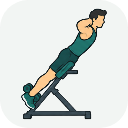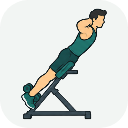
This is the loaded lower-back extension: the same hip-pinned hinge as a bodyweight back extension, but with a plate or dumbbell held at the chest so the set ends in a useful rep range instead of at forty. Tracking the weight is the point — the erectors respond to progressive load like anything else, and bodyweight-only extensions stop being a strength exercise once you can do twenty of them.
How to do it
- Move slowly. The lower back responds to control, not to speed or load.
- Stop at neutral rather than arching backwards.
Common mistakes
- Adding weight before the bodyweight version is comfortable for a full set.
What it trains
- Lower back
- extends the spine and holds it steady against the added plate
- Glutes
- finish the hip extension at the top of each rep
- Hamstrings
- anchor the hips and share the extension from the bottom
Variations and alternatives
Common questions
How do I hold the weight on a loaded back extension?
Hugged against your upper chest, not behind your neck. Behind the neck feels like it loads you more and does, but it also gives your neck the job of holding a plate while your spine moves, which is a bad trade. A dumbbell held vertically at the sternum is easiest to handle.
How many reps should I do with weight?
Eight to fifteen. The lower back responds well to moderate reps and badly to grinding heavy triples in a position where a rounded spine is the failure mode. If a weight lets you hit twenty, take the next plate up.
Do I need to train the lower back if I already deadlift?
Not strictly, but it helps — deadlifts train the erectors isometrically at one joint angle, and extensions train them through a range without loading the spine axially. It is also far less fatiguing, so you can add it on a day when another heavy pull would cost you.
In StackUp. Logged as weight and reps per set, and your heaviest working set decides whether the weight goes up next time. Get the app.
Back