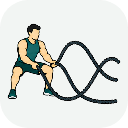
Battle ropes are conditioning done with your arms: two heavy ropes anchored at one end, waved, slammed or circled until you cannot hold the pace. Unlike most cardio the shoulders and grip are what fail first, which makes it a way to get your heart rate up on a day your legs are wrecked.
How to do it
- Athletic stance, soft knees, and drive the waves from the shoulders.
- Work in short intervals — this is conditioning, not a set of reps.
Common mistakes
- Standing upright and using only the arms, which tires the grip and nothing else.
What it trains
- Front delts
- raise and drive the rope on every wave — the first thing to burn out
- Forearms
- hold on, which is what actually ends most sets
- Abs
- brace against the rope pulling you forward, and work hard on slams
- Quads and glutes
- hold the half-squat stance and drive the hips on slam variations
- Heart and lungs
- the real target — the arms are just how you get there quickly
Variations and alternatives
Common questions
How long should a battle rope set be?
Twenty to forty seconds hard, then a minute or so off, repeated eight to twelve times. Much past forty seconds and the rope height collapses because your shoulders are gone, which is a different and much less useful session than the one you meant to do.
Do battle ropes build muscle?
Not much. The load per rep is low and the sets are long, so what you get is conditioning and grip endurance rather than size. Treat it as cardio you do standing up and it earns its place; expect shoulders from it and it will disappoint you.
Does rope thickness and length matter?
Yes, more than you would think. A 50 mm rope is far harder on the grip than a 38 mm one, and a longer rope is heavier and needs more range to make a wave reach the anchor. If your gym has two, note which one you used — the numbers are not interchangeable.
In StackUp. Logged with a stopwatch that keeps running if you leave the app. Get the app.
Full body