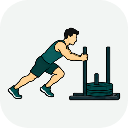
The sled push is driving a loaded sled across the floor for distance or time. There is no lowering phase at all, which is why it hammers your legs and lungs and yet leaves you barely sore the next day — it is the rare way to train legs hard without paying for it in recovery.
How to do it
- Lean into it with straight arms and take short, powerful steps.
- Low handles for more leg drive, high handles for a more upright push.
Common mistakes
- Bending the arms, which turns a leg exercise into an awkward press.
What it trains
- Quads
- extend the knee on every step — the prime mover, and where it burns
- Glutes
- drive the hip through each stride, more so with a low handle position
- Calves
- push off constantly from a forward-leaning stance
- Abs and lower back
- hold the lean so the force goes into the sled instead of folding you at the waist
- Heart and lungs
- the other half of the job — a heavy sled walk is conditioning whether you meant it or not
Variations and alternatives
Common questions
Why is the sled not making me sore?
Because there is no eccentric — you never lower anything, so the muscle damage that causes soreness barely happens. That is a feature: it is why a sled session can go in the day before or after a heavy squat without wrecking the next one.
How heavy should the sled be?
Two useful settings. Light enough to run behind gives you conditioning and speed; heavy enough that you grind at walking pace gives you leg strength and a savage heart rate. Both are valid — pick one for the session rather than a middling weight that does neither well.
How do I track sled pushes?
By distance and load together, since either on its own tells you nothing. Log the weight on the sled in your notes and record the distance or time as the set — StackUp tracks this one as time and distance rather than reps.
High handles or low handles?
Low for a more horizontal lean and more leg drive; high for a more upright push that lets you move faster and lets your arms and trunk take a share. Heavy grinding work suits the low position, sprints suit the high one.
In StackUp. Logged with a stopwatch that keeps running if you leave the app, plus distance. Get the app.
Full body