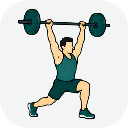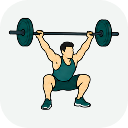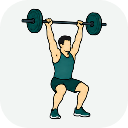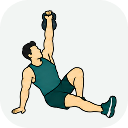
The Turkish get-up is standing up from lying on the floor while holding a weight locked out overhead, then reversing it step by step. It is slow, it is a sequence of positions rather than a rep, and the shoulder holding that weight overhead is doing the real work at every single stage.
How to do it
- Eyes on the weight for the whole movement until you are standing.
- Learn it with a shoe on your fist before you use a kettlebell.
Common mistakes
- Rushing the sequence. Every step is a position you should be able to hold.
What it trains
- Abs and obliques
- do the first half of the movement and control every rotation — the prime mover in practice
- Front delts
- hold the weight locked out through every position, which is what makes it tiring at light loads
- Glutes
- bridge the hips up and drive the stand from the lunge position
- Quads
- stand the half-kneeling position up and lower it back down under control
- Upper back
- keeps the loaded shoulder packed so the arm stays stable overhead
Variations and alternatives
Common questions
How heavy should a Turkish get-up be?
Far lighter than you expect to start. A shoe balanced on your fist is the traditional first step and it is not a joke — it exposes every wobble. Once the sequence is automatic, 8 to 16 kg is a solid working range for most people and heavier is a long project.
How many reps of the get-up should I do?
One to five per side, and treat each rep as its own set. Every rep takes half a minute or more, the whole value is in doing each position properly, and a fatigued get-up under load is just a slow mess.
Where should I be looking during a get-up?
At the weight, until you are standing — then forward, and back at the weight as you come down. Watching it keeps the shoulder in a good position and tells you immediately when the arm drifts, which is the fault every other fault follows from.
Is the get-up worth the time it takes?
It depends what you want. As shoulder stability and trunk control under load it is genuinely hard to replace. As muscle building it is poor — the loads are small and the reps are few, so it belongs at the start of a session as a skill, not in the middle as volume.
In StackUp. Logged as weight and reps per set, and your heaviest working set decides whether the weight goes up next time. Get the app.
Full body