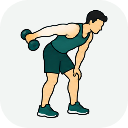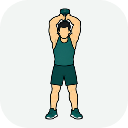
Taking the weight overhead puts the upper arm alongside your ear, which stretches the long head of the triceps across the shoulder joint — the one part of the muscle a pushdown barely touches. It is the triceps exercise most people are missing, and it is usually obvious from how much less weight it takes to make it hard.
How to do it
- Overhead puts the long head of the triceps on stretch — that is the reason to do it.
- Keep the elbows pointing forward rather than flaring out.
Common mistakes
- Going heavy in a position where the elbow has the least leverage.
What it trains
- Triceps
- extend the elbow, with the long head loaded through a stretch it never sees at your sides
- Shoulders
- hold the upper arms overhead for the whole set, which is its own kind of work
- Abs
- stop the ribs flaring and the back arching under an overhead load
Variations and alternatives
Common questions
One dumbbell in two hands or one in each?
One heavy dumbbell in both hands is easier to control and lets you load properly, so start there. Two dumbbells stop a strong arm helping the weak one but the wrists have to work harder to keep them tracking, and single-arm is the strictest of the three.
Why does my lower back arch on overhead extensions?
Because holding the arms overhead pulls the ribcage up unless you actively stop it. Do them seated with a backrest, brace your abs, and tuck the ribs down before the first rep. If the arch only appears at a given weight, that weight is past what your trunk will hold.
Do I need overhead work if I already do pushdowns?
If you want the long head trained through its full range, yes. Pushdowns keep the upper arm at your side, which never lengthens the long head across the shoulder, so the two are complements rather than alternatives. One of each is a complete triceps plan.
Why do my elbows hurt on this more than other triceps work?
The stretched overhead position loads the elbow at its most vulnerable angle, so it exposes anything that is already irritated. Keep the lowering slow instead of dropping into the stretch, use a rope on a cable instead of a dumbbell, and cut the range slightly rather than pushing through it.
In StackUp. Logged as weight and reps per set, and your heaviest working set decides whether the weight goes up next time. Get the app.
Arms