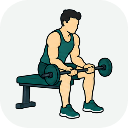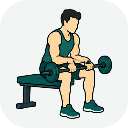
The reverse wrist curl lifts the back of the hand up with the forearm braced, training the wrist extensors on the top of the forearm — the side that every pulling movement in the gym ignores completely. The weights involved are small enough to be embarrassing, which is exactly why it is worth doing rather than skipping.
How to do it
- Palms down, lifting the back of the hand toward you.
- Much lighter than the palms-up version — the extensors are far weaker.
Common mistakes
- Matching the weight to your regular wrist curl.
What it trains
- Forearms
- the extensors on the top of the forearm lift the hand — the entire movement
- Grip
- holds the dumbbell in the fingers while the wrist does the work
Variations and alternatives
Common questions
How much weight should I use for reverse wrist curls?
Much less than you expect — the extensors are far weaker than the flexors, so a third of your wrist curl weight is a reasonable starting point. If the forearm has to swing to move it, halve it again.
Why does the top of my forearm ache when I grip things?
That side takes a beating from heavy holds and long typing days and rarely gets trained, so it is often the part that grumbles. Light reverse wrist curls with slow lowering is the usual training answer, but if it is persistent or sharp, that is a question for a physio rather than a rep scheme.
Should my forearm be flat on the bench?
Yes, from elbow to wrist, with only the hand hanging over the edge. If the forearm lifts as you curl, your elbow is doing the work and the exercise has quietly become something else.
In StackUp. Logged as weight and reps per set, and your heaviest working set decides whether the weight goes up next time. Get the app.
Arms