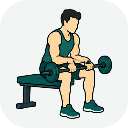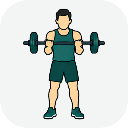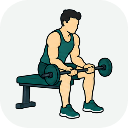
The wrist curl braces the forearm on a bench and curls the hand up, training the flexors on the underside — the muscles that close your hand and hold onto a bar. The range is tiny and the weight looks silly written down, but it is the most direct forearm work there is and the reps have to be slow for it to do anything.
How to do it
- Forearms on your thighs or a bench, wrists hanging over the end.
- Let the bar roll to the fingertips, then curl it back up.
Common mistakes
- Using weight that stops the wrist moving through its full range.
What it trains
- Forearms
- the flexors on the underside curl the hand up — the whole movement
- Grip
- the finger flexors work as you let the bar roll out and pull it back in
Variations and alternatives
Common questions
Do wrist curls actually make your forearms bigger?
They help, but heavy holds and carries do more for forearm size because they load far more weight for longer. Wrist curls are best as a supplement that covers the flexors directly, especially paired with the reverse version for the other side.
Should I let the bar roll down to my fingers?
Yes, if your grip can control it. Letting the bar roll out to the fingertips and pulling it back adds the finger flexors to the movement and roughly doubles what a tiny range gives you. Keep it slow, because a bar rolling out of an open hand is a dropped bar.
Dumbbells, a barbell or behind-the-back?
A barbell over the edge of a bench is the simplest and loads both hands evenly. Dumbbells let each wrist move independently and suit anyone with a wrist that dislikes a fixed bar. Behind-the-back standing wrist curls work the same muscles but are awkward to set up and to progress.
In StackUp. Logged as weight and reps per set, and your heaviest working set decides whether the weight goes up next time. Get the app.
Arms