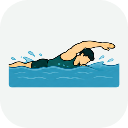
Swimming is cardio with no impact at all and your bodyweight held up by the water, driven mostly by the upper body in front crawl. It is the one common cardio option where technique limits you long before fitness does — which is either the appeal or the problem, depending on how you feel about learning a skill.
How to do it
- Breathe on a rhythm you can hold rather than whenever you run out.
- Count strokes per length — fewer strokes at the same pace means better technique.
Common mistakes
- Swimming harder to go faster when the answer is usually a longer, calmer stroke.
What it trains
- Lats
- pull you past your hand on every stroke — the main engine of front crawl
- Front delts and chest
- drive the catch at the front of the stroke and bring the arm over
- Abs and obliques
- hold the body flat and drive the rotation each stroke turns on
- Quads and glutes
- kick, which mostly keeps the legs up rather than pushing you forward
- Heart and lungs
- the actual target, and unusually here the breathing is rationed by the stroke
Variations and alternatives
Common questions
Why am I out of breath swimming when I can run for an hour?
Because you cannot breathe whenever you want and because bad technique costs enormous energy. Swimming fitness is largely a technique problem in disguise — a lesson or two will do more for your 400 m than months of thrashing up and down will.
Does swimming interfere with lifting?
Less than running does, for the legs at least, since there is no impact and no heavy eccentric loading. What it does compete with is upper body pulling — a hard crawl session and a heavy back day in the same 24 hours will be felt. Space them out and it sits well alongside lifting.
How should I structure a swim session?
In sets, like lifting. Something like eight lots of 50 m with twenty seconds rest teaches pace and keeps technique intact far better than swimming continuously until you are tired, because the stroke falls apart long before your legs do.
Should I track laps or time?
Distance and time together, since pace per 100 m is the number that actually shows improvement. StackUp logs swimming as time and distance — count laps, multiply by your pool length, and the pace falls out of it.
In StackUp. Logged with a stopwatch that keeps running if you leave the app, plus distance. Get the app.
Cardio