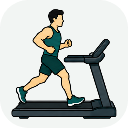
Treadmill running is steady or interval cardio with the surface, pace and gradient all under your control, which makes it the easiest running to repeat exactly — and repeatability is what lets you see whether your conditioning is actually improving rather than guessing from how it felt.
How to do it
- Set an incline of 1–2% so the belt is not doing part of the work for you.
- Land under your hips rather than reaching forward with the heel.
- Let go of the handrails — holding on changes the effort and the reading.
Common mistakes
- Holding the rails at a steep incline, which makes the number impressive and the session easy.
What it trains
- Quads and hamstrings
- drive each stride and absorb the landing
- Calves
- push off at every step — usually the first thing to feel it if you are new to running
- Glutes
- extend the hip, and do more of the work as the incline goes up
- Heart and lungs
- the actual training target — the legs are how you get at them
Variations and alternatives
Common questions
Will running undo my lifting gains?
Not at normal volumes. A few sessions a week of easy running alongside lifting is fine for nearly everyone; the interference people worry about shows up at high running volumes, and even then it hits leg strength first. Keeping hard runs off your heavy leg days handles most of it.
Should I set an incline?
One or two percent is a reasonable default — it roughly offsets the missing air resistance and stops you landing with a locked knee. Steeper than that becomes hill training, which is useful but is a different session.
Is the treadmill easier than running outside?
Slightly, at the same pace — the belt gives you no wind and a consistent surface. It is not enough to matter unless you are training for a specific race, and the trade is that a treadmill session is far easier to reproduce next week.
In StackUp. Logged with a stopwatch that keeps running if you leave the app, plus distance. Get the app.
Cardio