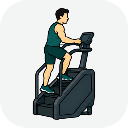
The stair climber is a rotating staircase you keep climbing, so every step is hip and knee extension against your full bodyweight. It sits between walking and running in cost — much harder than the treadmill at a comparable heart rate, and with none of the landing impact.
How to do it
- Full steps, standing tall, with only a light touch on the rails for balance.
- Let the heel land on each step rather than staying on the toes.
Common mistakes
- Hanging off the handles and taking half steps at a high speed setting.
What it trains
- Quads
- extend the knee to lift you onto each step — the main work on every stride
- Glutes
- drive the hip through, and take much more of it if you take two steps at a time
- Calves
- push off the top of each step and hold the ankle steady
- Heart and lungs
- the actual target, and this machine reaches them fast because it lifts all of you
Variations and alternatives
Common questions
Is it bad to hold on to the stair climber?
Leaning on it is, yes — resting your forearms on the rail and hanging off the machine takes a serious chunk of your bodyweight out of the exercise while the display carries on as if nothing changed. A light hand on the rail for balance is fine; if you need more than that, slow the machine down.
Should I take one step or two at a time?
One for steady conditioning, two when you want the glutes to do more. Double steps lengthen the range at the hip noticeably, and they are also where people start leaning on the handles — so they are worth doing slowly and honestly rather than quickly.
How long should a stair climber session be?
Fifteen to thirty minutes of steady work is plenty, and it is harder than the same time on a treadmill at a similar heart rate. If you are doing intervals, thirty seconds fast with a minute easy repeated eight or ten times works well on this machine.
In StackUp. Logged with a stopwatch that keeps running if you leave the app, plus distance. Get the app.
Cardio