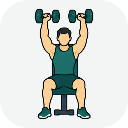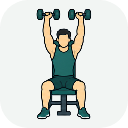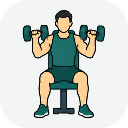
The Arnold press starts with the dumbbells in front of you, palms facing your body, and rotates them outward as you press overhead. The rotation means the front delts are loaded through a longer range than a normal press gives them, which is the entire reason to do it — and the reason it needs less weight.
How to do it
- Start with palms facing you and rotate outward as you press.
- Rotate on the way down too — the turn is the exercise.
Common mistakes
- Going heavy. The rotation under load is what the shoulder objects to.
What it trains
- Front delts
- work from a deeper, more stretched start than in a standard press
- Side delts
- take over as the arms rotate out and travel wide
- Triceps
- finish the rep once the rotation is complete
- Rotator cuff
- drives and controls the external rotation under load, which is why it needs a light start
Variations and alternatives
Common questions
Is the Arnold press better than a normal dumbbell press?
Not better, different. It gets more range out of the front delt and brings the side delt in earlier, but you will press noticeably less weight and the rotation under load does not suit every shoulder. Use it as a variation, not as your main press.
When should the rotation happen?
Early — finish turning the palms forward by about the time the dumbbells reach eye level, then press straight up from there. Rotating at the top is where people hurt themselves, because the shoulder is at its least stable with the arms nearly locked.
Why does the Arnold press feel so much harder at the same weight?
Because the starting position gives you almost no leverage and the rotation costs momentum you would otherwise keep. Expect to use roughly 20 to 30 percent less than your straight dumbbell press, and treat it as a separate exercise rather than a worse version of one.
In StackUp. Logged as weight and reps per set, and your heaviest working set decides whether the weight goes up next time. Get the app.
Shoulders