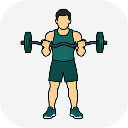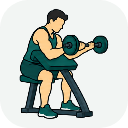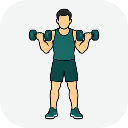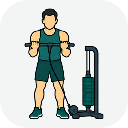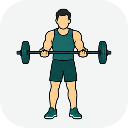
The barbell curl is the heaviest curl most gyms allow you to do, because both arms work against one bar and the strong side can quietly help the weak one. That is its point: it is the curl you load and progress on, with the fixed straight bar holding your wrists in full supination throughout.
How to do it
- Elbows at your sides and fixed there — they are a hinge, not a lever.
- Curl up, squeeze, and lower under control for the whole range.
Common mistakes
- Swinging the bar up with the hips, which makes the number bigger and the biceps smaller.
What it trains
- Biceps
- bend the elbow against the bar — the prime mover, and fully supinated the whole way
- Brachialis
- sits under the biceps and adds to the lift at every elbow angle
- Forearms
- hold the bar and stop the wrists collapsing back under load
- Front delts
- creep in as soon as the elbows drift forward — which is what turns a curl into a swing
Variations and alternatives
Common questions
Why do barbell curls hurt my wrists?
A straight bar locks your forearms into full supination, and not everyone has the forearm rotation for that with the elbows pinned at the sides. An EZ-bar solves it in one change by letting the hands sit at a slight angle, and dumbbells solve it completely because each wrist finds its own position.
Is swinging the bar up ever okay?
Only deliberately, at the end of a set, and never as how you do the reps. A controlled cheat rep to get past the sticking point followed by a slow lowering is a real technique; swinging from rep one just moves the work to your lower back and hips.
How wide should I grip the bar?
About shoulder width, with the forearms roughly vertical at the bottom. Much wider or much narrower puts a sideways twist through the wrist for no extra biceps involvement, and it is the usual reason a straight bar starts aching.
How do I keep adding weight when the jump is 2.5 kg?
Add reps before you add plates. A 2.5 kg jump on a 30 kg curl is over 8 %, which is a big step for a small muscle, so work up through your rep range first and take the jump only when you top it. Set the range in StackUp and it tells you when that moment arrives.
In StackUp. Logged as weight and reps per set, and your heaviest working set decides whether the weight goes up next time. Get the app.
Arms