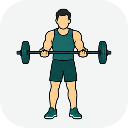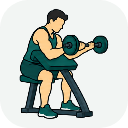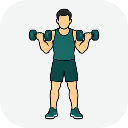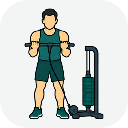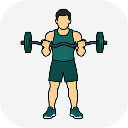
The EZ-bar is a cambered barbell whose bends let your hands sit half-turned rather than fully palm-up, which takes the strain off the wrists that a straight bar puts there. You give up a little biceps supination for it, and for most people that is a trade worth making because it means curling heavy without an ache.
How to do it
- The angled grip takes strain off the wrists compared to a straight bar.
- Same rule as any curl: the elbows stay put.
Common mistakes
- Letting the elbows drift forward at the top, which gives the biceps a rest mid-set.
What it trains
- Biceps
- the prime mover, working slightly shortened compared with a fully supinated grip
- Brachialis
- takes a little more of the load than on a straight bar, because of the angled grip
- Forearms
- hold the bar in a neutral-ish position that far fewer wrists complain about
Variations and alternatives
Common questions
EZ-bar or straight bar for curls?
EZ-bar if a straight bar makes your wrists ache, straight bar otherwise. The straight bar keeps the palms fully up, which is the biceps in its strongest and most complete position, but no amount of theory beats being able to load a lift without pain.
Which set of bends should I hold?
The inner bends for a narrower, more angled grip and the outer ones for something close to a straight bar. Try both — the right answer is the one where your wrists stay quiet, and it differs between people with the same bar.
Do I count the bar weight?
Yes, and check it — an EZ-bar is usually 7 to 12 kg depending on the gym, not the 20 kg you would assume from an Olympic bar. Weigh it once and log the true total, or your numbers drift against every other gym you ever train in.
In StackUp. Logged as weight and reps per set, and your heaviest working set decides whether the weight goes up next time. Get the app.
Arms