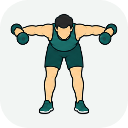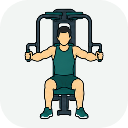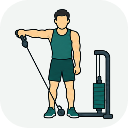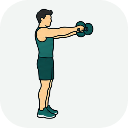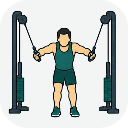
The cable rear delt fly crosses two high pulleys in front of you and pulls the handles apart and back. Compared with the dumbbell version it holds tension across the whole arc instead of just the top, and you do it standing upright, so your lower back is not the thing that ends the set.
How to do it
- Cross the cables in front of you and pull outward and slightly back.
- Keep the elbow angle fixed the whole way.
Common mistakes
- Using enough weight that the upper back joins in and the rear delt stops working.
What it trains
- Rear delts
- pull the arms back and out against a constant line of pull
- Upper back
- retracts the shoulder blades as the hands travel past your torso
- Traps
- assist, more the higher you set the pulleys
Variations and alternatives
Common questions
How high should the pulleys be?
Roughly shoulder height for the most direct rear delt line, higher if you want more upper back involvement. Crossing the cables so each hand takes the opposite handle gives you a longer range than pulling straight out.
Is this better than a reverse pec deck?
It offers a longer range and more freedom in the path; the pec deck is easier to set up and easier to push to failure on. Neither is clearly better, and plenty of people rotate between them just to keep the movement fresh.
Should my arms be straight or bent?
Slightly bent and locked there for the whole rep. Straight arms make the lever unmanageable on anything but a tiny weight, and letting the elbow open and close turns the fly into a triceps movement.
In StackUp. Logged as weight and reps per set, and your heaviest working set decides whether the weight goes up next time. Get the app.
Shoulders