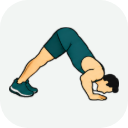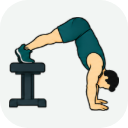
The elevated pike push-up is a pike push-up with your feet on a bench, which tips your torso close to vertical and puts most of your bodyweight over your hands. It is the last step before a handstand push-up against a wall, and it needs nothing but a bench. You will also see it called an inverted push-up.
How to do it
- Feet on a bench, hands on the floor, then walk your hands in until your hips are high over your shoulders.
- Lower the top of your head toward a point just in front of your hands, elbows at about 45°.
- Press until your arms are straight, pushing the floor away at the top.
Common mistakes
- Dropping into the bottom instead of lowering, with most of your bodyweight heading for your head.
- Letting the hips drift back toward the bench, which flattens the angle into an easier decline push-up.
What it trains
- Front delts
- carry the press — with the torso near vertical, almost all of it
- Triceps
- lock the elbows out at the top, where the extra load shows first
- Upper chest
- helps at the bottom, and less the higher your hips sit over your hands
- Core
- keeps your hips stacked over your shoulders instead of drifting back toward the bench
Variations and alternatives
Common questions
How high should the bench be for elevated pike push-ups?
Start with a normal flat bench at about knee height. A higher box stands your torso up more and makes the press harder; once you are close to vertical, you are effectively doing a handstand push-up with your feet supported. Go higher only when you manage around ten clean reps at the current height.
How do I get into position safely?
Put your hands on the floor in front of the bench, place your feet on it one at a time, then walk your hands back toward it until your hips are over your shoulders. To finish, walk your hands forward first and step down one foot at a time. Most wobbles happen getting in and out, not during the set.
Why is it so much harder than a normal pike push-up?
Because raising your feet moves more of your bodyweight onto your hands and makes the press more vertical, so the chest helps the shoulders less. Expect noticeably fewer reps at first. StackUp keeps the two as separate exercises and raises your target reps on each as you reach the top of your range.
When am I ready for handstand push-ups?
When you can do eight to ten clean reps with your torso close to vertical and your head nearly reaching the floor. Then a handstand push-up against a wall is the next step, at first with a folded mat under your head and a shorter range. Keep this version too — it is where your volume comes from while the handstand reps are still few.
In StackUp. Logged as reps per set. Add weight if you use a belt or a dumbbell and StackUp progresses it like any other lift. Get the app.
Shoulders