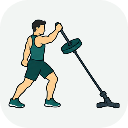
The landmine press uses one end of a barbell anchored in a corner or a landmine sleeve, so the bar travels up and forward on an arc rather than straight overhead. That angle is what makes it useful: it loads the front delt and upper chest hard while keeping the shoulder well short of the overhead position.
How to do it
- The arc of the landmine is kinder to the shoulder than a straight overhead press.
- Press up and slightly across, finishing with the arm extended in front of you.
Common mistakes
- Twisting the torso to get more weight up instead of pressing it.
What it trains
- Front delts
- drive the arc up and away — the prime mover
- Upper chest
- contributes far more than in a true overhead press, because the path is partly horizontal
- Triceps
- extend the elbow through the second half of the arc
- Abs and obliques
- resist the twist and lean, especially pressing one arm at a time
Variations and alternatives
Common questions
How do I set up a landmine press without a landmine attachment?
Wedge one end of the bar into a corner, ideally with a towel or a heavy dumbbell holding it down so it cannot skate out. It works fine, but check the floor and the wall first — an unanchored bar sliding mid-rep is the only real hazard here.
Is a landmine press a shoulder or a chest exercise?
Mostly shoulders, with a genuine share going to the upper chest. The steeper the bar angle, the more it behaves like an overhead press; the shallower it is, the closer it gets to a steep incline press.
Should I press with one arm or two?
One arm gives you a longer range and makes the trunk work to stop you rotating. Two hands on the end lets you load it heavier and keeps it symmetrical. Single-arm is the more common choice, and it is the one that exposes a side-to-side difference.
Why does the landmine press feel easier on my shoulders?
Because your arm never goes fully overhead, so the shoulder stays in a range where it has more room. That is a mechanical difference, not a fix for anything — but it is why the landmine is often the press people keep when a straight bar overhead stops being comfortable.
In StackUp. Logged as weight and reps per set, and your heaviest working set decides whether the weight goes up next time. Get the app.
Shoulders