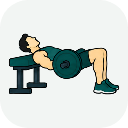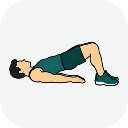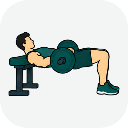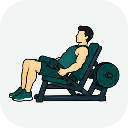
The machine hip thrust is the same hip extension on a fixed path, with a pad across your hips and a weight stack or plate loading instead of a barbell. The setup is the whole argument for it — no rolling a loaded bar into place, no bench sliding away mid-set, so you get to the working sets with none of the faff.
How to do it
- Set the pad across the hips, not the stomach, before you load it.
- Same finish as the barbell version: full extension, ribs down, brief hold.
Common mistakes
- Half reps at a heavier setting — the top position is where the glute actually works.
What it trains
- Glutes
- drive the pad up to lockout — the prime mover, and they stay it because nothing has to be balanced
- Hamstrings
- assist at the hip, with the share set by where the footplate puts your feet
- Abs
- hold the trunk against the back pad so the hips do the extending
Variations and alternatives
Common questions
Is the machine hip thrust as good as the barbell version?
For the glutes, very close, and it is considerably more pleasant to set up. What you lose is the bracing and balancing work of holding a loaded bar in place, and the fact that the machine picks your torso angle for you rather than letting you find one that suits your build.
Why is the weight on the machine not comparable to my barbell number?
Because makers load these differently — some through a lever arm, some through a cam, some plate-loaded at an angle — so one gym's 100 kg is another's 140. Track each machine as its own exercise and compare it only with itself.
How should I set the footplate?
So your shins are vertical at full lockout, not at the bottom. Set the top of the rep first and work backwards; most people leave the plate wherever the last user had it and then wonder why they feel it in their quads.
In StackUp. Logged as weight and reps per set, and your heaviest working set decides whether the weight goes up next time. Get the app.
Glutes