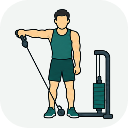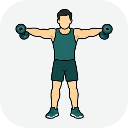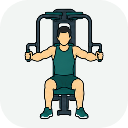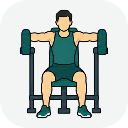
The machine lateral raise pads your upper arms and moves them out on a fixed arc, so there is no balancing and no way to swing the weight up. That makes it the easiest lateral raise to take to genuine failure — which matters more on this movement than most, because a side delt set only gets hard in its last few reps.
How to do it
- Set the pads at the elbow, not the wrist, so the arm is not doing the lifting.
- Pause at the top where the machine has the least leverage.
Common mistakes
- Bouncing the stack, which the machine makes easy and pointless.
What it trains
- Side delts
- push the pads outward — the machine removes almost everything else
- Traps
- assist near the top of the arc, less than on a free-weight raise because you cannot shrug into the pads
Variations and alternatives
Common questions
How do I set up a lateral raise machine?
Seat height so the pivot sits level with your shoulder joint, not your elbow. Get that wrong and the arc fights your shoulder the whole way, which is why the machine feels awkward to a lot of people who never adjusted it.
Should I push with my elbows or grip the handles?
Drive with the pads on your upper arms and hold the handles loosely. Pulling hard with the hands lets the arms and traps contribute, which is the one thing the machine exists to stop.
Is the machine version as good as dumbbell lateral raises?
For the side delt specifically, yes, and arguably better because you cannot cheat the weight up. What you lose is the stabilising work and the option to adjust the path to your own shoulder, which some people need.
In StackUp. Logged as weight and reps per set, and your heaviest working set decides whether the weight goes up next time. Get the app.
Shoulders