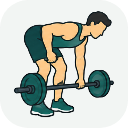
The Pendlay row is a barbell row from a dead stop on the floor with your torso held at roughly parallel for every rep. Resetting on the floor kills all momentum and means each rep starts from the same position, which makes it far more honest than a touch-and-go row — and far harder, because you get no help from the stretch reflex.
How to do it
- Torso parallel to the floor, and the bar returns to the floor between every rep.
- Each rep starts dead — that is the point, and it is what makes it different from a barbell row.
Common mistakes
- Letting the torso rise, which quietly converts it into an ordinary barbell row.
What it trains
- Upper back
- pulls the bar off the floor to the ribs, from a standing start with nothing stored
- Lats
- drive the elbows back and down through the middle of the pull
- Lower back
- holds the torso at parallel, which is a harder hold than the 45° of an ordinary row
- Hamstrings
- hold the hips hinged for the length of the set
Variations and alternatives
Common questions
What is the difference between a Pendlay row and a barbell row?
The bar rests on the floor between reps and the torso stays at parallel. An ordinary barbell row keeps tension throughout and lets you row from a higher, more comfortable angle. Pendlay rows are stricter and usually lighter; the ordinary row is the one you can load hardest.
Should the bar bounce off the floor?
No — a full stop, then pull again. Bouncing turns the reset into a stretch reflex and you have rebuilt the touch-and-go row while carrying the disadvantage of the harder torso angle.
Why is my Pendlay row so much weaker than my barbell row?
Because you have removed both the momentum and the friendlier torso angle. A 25 to 30 percent drop is normal and expected. Log them as separate exercises rather than trying to reconcile the numbers.
Do I need bumper plates?
No, but you do need 20 kg plates or a rack of blocks, because the bar has to start at roughly deadlift height. Rowing from small plates on the floor drops the bar far too low and the reps become half deadlifts.
In StackUp. Logged as weight and reps per set, and your heaviest working set decides whether the weight goes up next time. Get the app.
Back