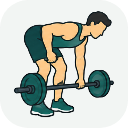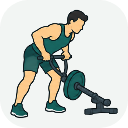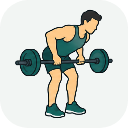
The barbell row is the heaviest horizontal pull you can load, done bent over at the hips with the bar pulled to your stomach and lowered under control. What makes it different from every supported row is that your lower back and hamstrings hold the bent-over position for the whole set — that is a real part of the exercise and the reason it builds more than the machines, and also the reason it is the one most people cheat.
How to do it
- Hinge to roughly 45° and hold that torso angle for the whole set.
- Pull the bar to your lower ribs, leading with the elbows.
Common mistakes
- Standing up a little on every rep, which turns a row into a shrug with extra steps.
What it trains
- Upper back
- retracts the shoulder blades and pulls the elbows past the torso
- Lats
- drive the upper arms back and down, more so the closer you tuck the elbows
- Lower back
- holds the bent-over position for every rep — usually what ends the set before the back does
- Biceps
- bend the elbows, and take over quickly if the bar path drifts in front of you
- Hamstrings and glutes
- hold the hips hinged back against the weight
Variations and alternatives
Common questions
How bent over should I be for barbell rows?
Around 45° or lower at the torso. Higher than that and the bar path shortens into something closer to an upright row, which is a different exercise with a different weight. If you can only hold 45° for the first three reps, the bar is too heavy.
Where should the bar touch?
Somewhere between the bottom of your ribs and your navel, depending on how bent over you are. Pulling high to the chest turns it into a rear-delt movement; pulling to the hips shortens the range. Pick one contact point and keep it the same across sets so the weight means something.
Why does my lower back give out before my back does?
Usually because the weight is past what you can hold hinged, not past what you can pull. Drop 10 kg and see if the last rep still looks like the first. If it keeps happening at reasonable weights, put your heavy rowing on a chest-supported row and keep the barbell version lighter.
Overhand or underhand grip?
Overhand for the upper back, underhand if you want more lat and more biceps and a slightly heavier bar. Underhand rows let most people use more weight, which is worth knowing before you compare the two numbers and conclude something about your back.
In StackUp. Logged as weight and reps per set, and your heaviest working set decides whether the weight goes up next time. Get the app.
Back