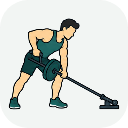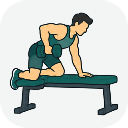
The one-arm dumbbell row is a row done a side at a time with your free hand braced on a bench, and the independent arm is what makes it worth doing — you get a longer pull than a bar allows, a stretch at the bottom nothing else matches, and no way for the strong side to carry the weak one. It also loads your obliques quietly, because one side of you is holding still against a weight trying to twist you.
How to do it
- Brace one hand and knee on the bench so your back is flat, not twisted.
- Pull the dumbbell to your hip rather than your shoulder.
Common mistakes
- Rotating the torso to get the last rep, which loads the lower back instead of the lat.
What it trains
- Lats
- drive the upper arm back and down, through a longer range than a barbell permits
- Upper back
- retracts the shoulder blade at the top of the pull
- Biceps
- bend the elbow as the dumbbell comes to the hip
- Obliques and lower back
- resist the rotation a one-sided load puts on your torso
Variations and alternatives
Common questions
Should I row to my hip or my chest?
To the hip, with the elbow brushing past your ribs, if you want the lats. Rowing high toward the armpit or chest shifts the work to the rear delts and upper back, which is a valid choice but a different exercise — do not mix the two inside one set.
Is it OK to twist my torso at the top of a dumbbell row?
A small amount of shoulder rotation as the arm goes back is fine and follows the shoulder blade. What is not fine is turning the whole torso to throw the dumbbell up, which is the usual reason someone rows 40 kg for eight with no soreness afterwards.
Hand on the bench or hand on a dumbbell?
Hand on the bench is more stable and lets you go heavier. Standing hinged with the free hand on a rack is harder on the lower back but keeps you more upright, which suits people who find the bench version bunches their shoulder. Either works; the bench version is the default for a reason.
How much heavier can my strong side go?
Do not find out. Work both sides with what the weaker one can handle for the target reps, and start each set with the weaker arm. A one-arm row is the best chance you get to stop a side imbalance growing, and chasing the strong side wastes it.
In StackUp. Logged as weight and reps per set, and your heaviest working set decides whether the weight goes up next time. Get the app.
Back