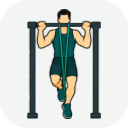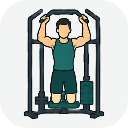
The assisted pull-up machine is a pull-up with a counterweighted platform pushing you back up, so you pick how much of your bodyweight you actually lift. It is the only vertical pull that lets you train the real movement, hanging and through full range, before you can do a single unassisted rep. The counter-intuitive part is the numbers: a bigger plate means more help, so the weight you want going down over time, not up.
How to do it
- More counterweight means more help, not less — it is the opposite of loading a stack.
- Use the same form you want unassisted, and reduce the help over weeks.
Common mistakes
- Staying on the same assistance forever — it is a progression tool, not a station.
What it trains
- Lats
- pull the upper arms down and back to drive you up to the bar
- Biceps
- bend the elbows, and take a bigger share on the neutral or underhand handles
- Upper back
- retracts the shoulder blades at the top of each rep
- Core
- stops the knees swinging the platform and turning the rep into a kip
Variations and alternatives
Common questions
How much assistance should I set on the machine?
Enough to get 6 to 10 clean reps, and no more. If you are finishing 15 with the plate still moving fast, you are training the pattern but not much else. Drop the assistance by one plate whenever you top your rep range.
Is the assisted pull-up machine better than lat pulldowns for getting a first pull-up?
Yes, marginally, because you are hanging from your own arms and moving your own body — the stabilising work is real in a way a seated pulldown cannot copy. The pulldown still earns its place for higher-rep back volume, and most people get to a first rep faster doing both.
Why does less weight feel harder on this machine?
Because the stack is assistance, not load. The plate you select is pushing you up, so subtracting from it means lifting more of yourself. It is the one machine in the gym where the stack runs backwards, and it catches nearly everyone the first time.
Should I put my knees or my feet on the pad?
Knees on most machines, feet if the model has a foot platform. Knees kneeling is more stable and easier to get in and out of under fatigue; a foot platform lets you step off mid-set, which is handy if you want to grind out a last assisted-free rep.
In StackUp. Logged as weight and reps per set, and your heaviest working set decides whether the weight goes up next time. Get the app.
Back