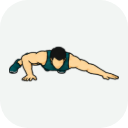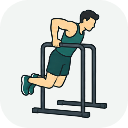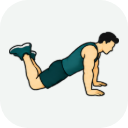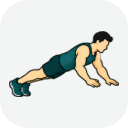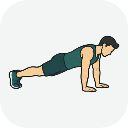
The push-up is the bodyweight press: the same chest, shoulder and triceps pattern as a bench press, done against a share of your own weight with your trunk holding a plank throughout. It needs no equipment, and it scales from knees to one arm, which is why it survives in every training programme ever written.
How to do it
- Hands just outside shoulder width, body in one line from head to heels.
- Lower your chest to just above the floor with your elbows around 45°.
- Squeeze your glutes — that is what stops your hips sagging.
Common mistakes
- Hips sagging or piking up, which turns one exercise into neither.
- Only going halfway down and counting it as a rep.
What it trains
- Chest
- drives the body away from the floor — the prime mover
- Triceps
- extend the elbows, and take much more of the work with the hands close
- Front delts
- assist the press, especially in the first few inches off the floor
- Abs
- hold the hips in line — the reason a push-up is a trunk exercise as well as a press
Variations and alternatives
Common questions
How do I get better at push-ups if I cannot do one?
Raise your hands. Push-ups against a wall, then a bench, then a low box are the same movement at a fraction of the load, and they progress to the floor far more reliably than knee push-ups do. Log the incline height as you lower it so you can see the progression.
How do I keep making progress once I can do 30?
Add load rather than reps — feet elevated, a band across the back, or a plate. Endless high-rep sets drift into endurance training; StackUp lets you log added weight on a rep-based exercise for exactly this reason.
Where should my hands be?
A little wider than your shoulders, with the elbows travelling back at roughly 45° rather than straight out to the sides. Hands very wide shortens the range and stresses the shoulder; hands under the chest makes it a triceps exercise.
In StackUp. Logged as reps per set. Add weight if you use a belt or a dumbbell and StackUp progresses it like any other lift. Get the app.
Chest