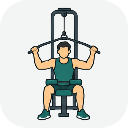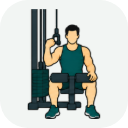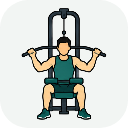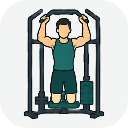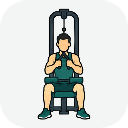
The close-grip pulldown uses a narrow V-handle or a shoulder-width bar, which lets your elbows travel close to your ribs and gives you a longer pull than a wide grip does. That extra range and the stronger biceps position mean you will usually handle more weight here than on the wide-grip version — it is the pulldown to pick when you want to load the pattern hard.
How to do it
- A close or neutral grip gives more range and brings the lower lats in.
- Keep the torso upright and let the bar come to the sternum.
Common mistakes
- Leaning back far enough that it becomes a row.
What it trains
- Lats
- pull the upper arms down and in tight to the ribs, through a longer range than a wide grip allows
- Biceps
- bend the elbows, and take noticeably more of the load than on a wide grip
- Upper back
- retracts the shoulder blades at the bottom of each rep
- Lower lats and teres
- finish the pull as the elbows come past your sides
Variations and alternatives
Common questions
Does a close grip build the lower lats?
It works them through a longer range, which is the grain of truth behind the claim. You cannot target a region of a muscle the way the phrasing implies, but pulling the elbows tight to the ribs does load the lats in a position a wide grip never reaches, and that is worth having in the programme.
V-bar or straight bar for close-grip pulldowns?
The V-bar, if the gym has one. The neutral grip is kinder on the wrists and elbows at heavy loads and most people can pull more with it. A straight bar at shoulder width is a fine substitute and slightly more biceps-heavy.
Why can I pull more close-grip than wide-grip?
Shorter moment arm at the shoulder plus a much stronger biceps position. Both are real mechanical advantages, so a gap of 10 to 15 kg between the two grips is normal and says nothing about your back.
In StackUp. Logged as weight and reps per set, and your heaviest working set decides whether the weight goes up next time. Get the app.
Back