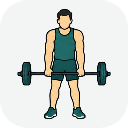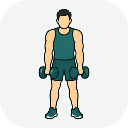
The dumbbell shrug loads the traps by simply lifting your shoulders toward your ears with a weight hanging in each hand. The dumbbell version beats the barbell one in a specific way: the weights hang beside your legs instead of in front of them, so you can shrug straight up rather than slightly forward, and you can go deeper at the bottom without the bar hitting your thighs.
How to do it
- Dumbbells at your sides, arms relaxed, and lift with the traps only.
- Use straps if your grip fails before your traps do.
Common mistakes
- Bending the elbows, which turns it into a very short upright row.
What it trains
- Traps
- elevate the shoulder blades — essentially the only thing moving
- Forearms
- hold the dumbbells for the whole set; grip is usually what ends it
- Levator scapulae
- assists the upper traps in lifting the shoulder blade
Variations and alternatives
Common questions
Should I roll my shoulders during shrugs?
No. Rolling adds a loaded circle at the top that the traps do not drive and your shoulder joint does not need. Straight up, pause, straight down — the only direction the traps actually pull.
Do I need straps for dumbbell shrugs?
Once the dumbbells get heavy, yes. Your grip fails long before your traps do, and shrugs are one of the few exercises where that limit is purely a nuisance. If you would rather train the grip, do the heavy sets strapped and finish with an unstrapped hold.
How many reps for shrugs?
Ten to twenty. The traps respond well to volume and the range of motion is short, so heavy triples mostly teach you to bounce. Pause for a second at the top of each rep and the weight you need drops considerably.
In StackUp. Logged as weight and reps per set, and your heaviest working set decides whether the weight goes up next time. Get the app.
Back