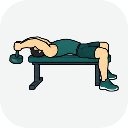
The dumbbell pullover has you lying across or along a bench, taking one dumbbell from behind your head to over your chest with the arms nearly straight. It is the only common lat exercise with no elbow bend to speak of, so the biceps cannot take over — the trade-off is that the resistance disappears once the weight is above your chest, so the stretched bottom half is the useful part.
How to do it
- Lie across or along a bench, dumbbell held over the chest with both hands.
- Lower behind the head only as far as the shoulder allows comfortably.
Common mistakes
- Chasing depth behind the head with a heavy dumbbell.
What it trains
- Lats
- pull the upper arms from overhead down toward the torso, working hardest at full stretch
- Chest
- shares the same job — how much depends on your elbow width and bench angle
- Triceps
- the long head holds the elbow position against the weight behind your head
- Abs
- stop the ribcage flaring as the weight goes overhead
Variations and alternatives
Common questions
Is the pullover a chest exercise or a back exercise?
Both, and the split depends on how you do it. Elbows tucked in and a flat back keeps it on the lats; elbows flared with the ribcage allowed to open puts more on the chest. Neither version is wrong, but decide which one you are doing before you pick the weight.
Should I lie along the bench or across it?
Along it is far easier to set up and to get out of under fatigue. Lying across with the hips low is the classic version and gives a longer range at the bottom, but it asks your glutes to hold a bridge for the whole set, which is a distraction more than a feature.
How far back should I lower the dumbbell?
Until you feel the stretch through the lats and ribs, and not past the point where your shoulders feel loose. That is usually around head height or slightly below, and going further gains nothing because the lats are no longer the thing being loaded there.
In StackUp. Logged as weight and reps per set, and your heaviest working set decides whether the weight goes up next time. Get the app.
Back