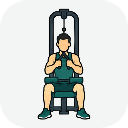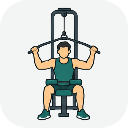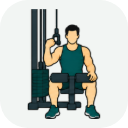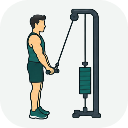
The straight-arm pulldown takes a high cable and pushes it down in an arc to your thighs with the elbows locked, which loads the lats with the elbows entirely out of the equation. It is the closest thing the lats have to a pure isolation movement, so it is useful when your biceps or grip are limiting your rows and pulldowns, and it costs almost nothing to recover from.
How to do it
- Arms nearly straight and fixed — the movement happens at the shoulder only.
- Pull the bar to your thighs and feel the lats rather than the triceps.
Common mistakes
- Bending the elbows, which makes it a pushdown for the triceps instead.
What it trains
- Lats
- pull the straight arms from overhead down to the thighs — nothing else can do this job
- Triceps
- the long head holds the elbows locked against the cable
- Abs
- stop the torso rising as the cable tries to pull you up
Variations and alternatives
Common questions
Should my arms be completely straight?
A fixed slight bend, not a locked-out straight. Keeping a small angle at the elbow and never changing it through the rep is the goal — the moment the elbow starts to bend and straighten you have built a triceps pushdown instead.
Straight-arm pulldown or pullover?
The cable version if you want even tension through the whole range, the dumbbell pullover if you want a hard stretch at the bottom. The cable also lets you keep going in very small weight increments, which matters on a movement where 2.5 kg is a real jump.
Where should the cable finish?
At your thighs, with your shoulders pulled down and back. Pushing past your legs means leaning forward to get there, which stops loading the lats and starts loading your lower back for nothing.
In StackUp. Logged as weight and reps per set, and your heaviest working set decides whether the weight goes up next time. Get the app.
Back